AI has changed how people look for information. They now ask questions—plain ones, spoken in their own words. They expect the answer to be just as plain. It no longer matters whether they ask Google, Bing, ChatGPT, Perplexity, or a voice assistant; the expectation is the same: clarity.
For anyone publishing online, this means your job is no longer to chase the old top-10 links. It’s to become the answer. That’s what Answer Engine Optimisation (AEO) is about.
Below is a practical checklist for teams who want to do AEO well. You’ll need curiosity, discipline, and a willingness to challenge some SEO habits that no longer serve you. Incorporate this AEO checklist into your AI writing process workflow.
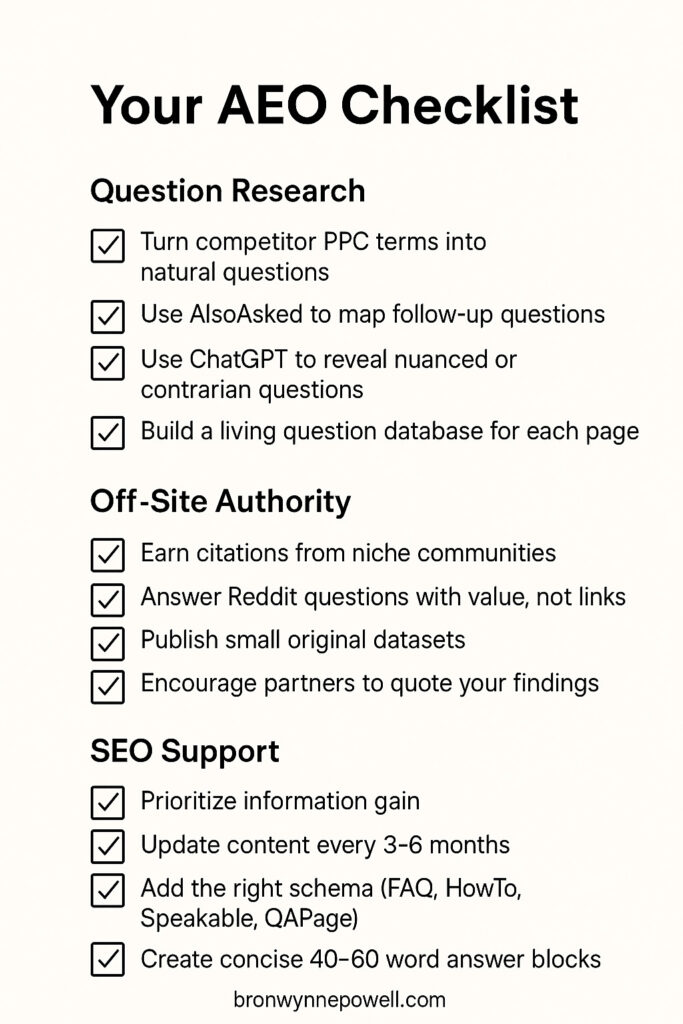
1. Build an AEO Question Bank With Intent-Driven Research
Modern search engines start with questions, not keywords. So should you. Create a living library of real questions, phrased the way real people ask them.
a. Turn Competitors’ PPC Terms Into Questions
Paid teams do some of the best intent research you’ll ever find. Use it.
Export your competitors’ PPC keyword lists and reshape those phrases into the kinds of questions someone would ask a human, not a machine.
- PPC: crm for freelancers → “What’s the easiest CRM for freelancers who work alone?”
- PPC: email automation examples → “What are examples of email automations that actually improve conversions?”
b. Use AlsoAsked and AnswerThePublic
These tools reveal the follow-up questions readers ask once they understand the basics. They’re valuable because most teams stop at the basics.
Search “user research” on AlsoAsked and you’ll find things like, the steps and principles of user research.
- “What is the first step in customer journey mapping?”
- “What tools are used for customer journey mapping?”
- “What does a journey map look like in practice?”
Each one is an opportunity to directly answer a question with demonstrated interest.
c. Use ChatGPT as a Research Partner, Not a Content Machine
Most teams use ChatGPT to write. You’ll get more value by refining your prompt.
Try this:
“Act as a user researcher. Give me 20 specific, nuanced questions a marketing manager would ask before choosing a CRM for a team of five.”
Then ask for variations by experience level, industry, or frustration.
ChatGPT’s deep research feature is especially useful in this regard.
2. Off-Site Authority Building: Earn Citations, Not Just Links
AEO isn’t confined to your website. Answer engines build their understanding of the world from every corner of the web. Think of resources like forums, newsletters, transcripts, niche blogs. AI platforms treat these citations as signals of trust.
a. Become a Source in Specialist Communities
LLMs repeat the sources they see often. If you show up across respected niche communities, you become part of the vocabulary they use to answer questions.
Strong sources include:
- Industry newsletters
- Press releases
- Expert roundups
- Subreddits
- Podcast transcripts (LLMs ingest these heavily)
Small signals add up over time to build your credibility.
b. Answer Reddit Questions Thoughtfully, Never With Links
Reddit is one of the most influential datasets for LLMs. But Reddit users punish self-promotion.
Your job there is simple: be useful.
One strategist answered a question on r/marketing about staying consistent with an editorial calendar. No links, no pitch—just a three-step framework. That answer was later quoted in several articles and a LinkedIn post, and all of them linked back to his company.
The lesson: Help first. Visibility follows.
c. Publish Data
You don’t need a massive survey. You need something real.
A set like “150 SaaS onboarding emails” or “40 landing pages with above-average conversion rates” can earn citations, embeds, and mentions in AI summaries. LLMs favour original observations over recycled ones.
Publish small insights consistently.
3. SEO Best Practices That Support AEO
Traditional SEO still matters, but not equally. Certain habits work directly in your favour when answer engines decide what to surface.
a. Information Gain: Add the One Thing Everyone Else Missed
Information Gain is simple: what new value do you add?
You can create information gain through a clearer definition, a comparison others looked, or stories that show your idea working in real life.
For example, if every article explains “content clusters,” add a new angle:
“The mistake most teams make with content clusters is treating them as checklists instead of narratives.”
Answer engines reward the angle that helps readers understand the idea, not the angle that pads the article.
b. Recency Bias: Update Without Rewriting
Search engines and LLMs take timestamps seriously. You don’t need to overhaul your work, keep it alive with relevant updates.
Swap in recent stats. Add a short note about a new update, or replace an outdated example.
c. Use the Right Schema
Schema helps machines understand what you’re trying to do. Useful types for AEO include FAQ pages, articles, and bios.
AEO Is a Solid Content Habit
AEO isn’t a trick. It’s a way to give readers the clearest answer you can. The brands that succeed won’t be the ones with the longest content or the largest link profile. They’ll be the ones willing to be plain, helpful, and human.
